The best built-in basement dehumidifiers
An installed dehumidifier is not a bigger portable. It is a different appliance with a drain, a duct and a ten-year expectation, and it is bought on different numbers.
We earn a commission if you buy through our Amazon links, at no cost to you. We do not bench-test these products and we never take free product — how we pick · affiliate disclosure
The best built-in basement dehumidifier is the AprilAire E080: 80 pints a day across 4,400 square feet, an ENERGY STAR Most Efficient rating for 2025 at 632 kWh a year, a washable MERV 8 filter, and the flexibility to run ducted into the house or free-standing in the basement. If your basement has no floor drain, the AlorAir Sentinel HDi90 has a condensate pump inside it and runs down to 34 F. If the space is a crawl space with no room for a cabinet, the Santa Fe Compact70 fits in 12 x 12 x 21 inches and filters to MERV-13.
Be clear what this appliance does before you spend on one. A dehumidifier manages moisture that is already in the air. It does nothing about water arriving through a wall, a cove joint or a failed grade, and installing one to treat a wet basement is paying a monthly electricity bill to manage a symptom. Fix the water first — how to waterproof a basement — then dry the air that is left.
Quick picks
| # | Product | Best for | Score | Price |
|---|---|---|---|---|
| 1 | 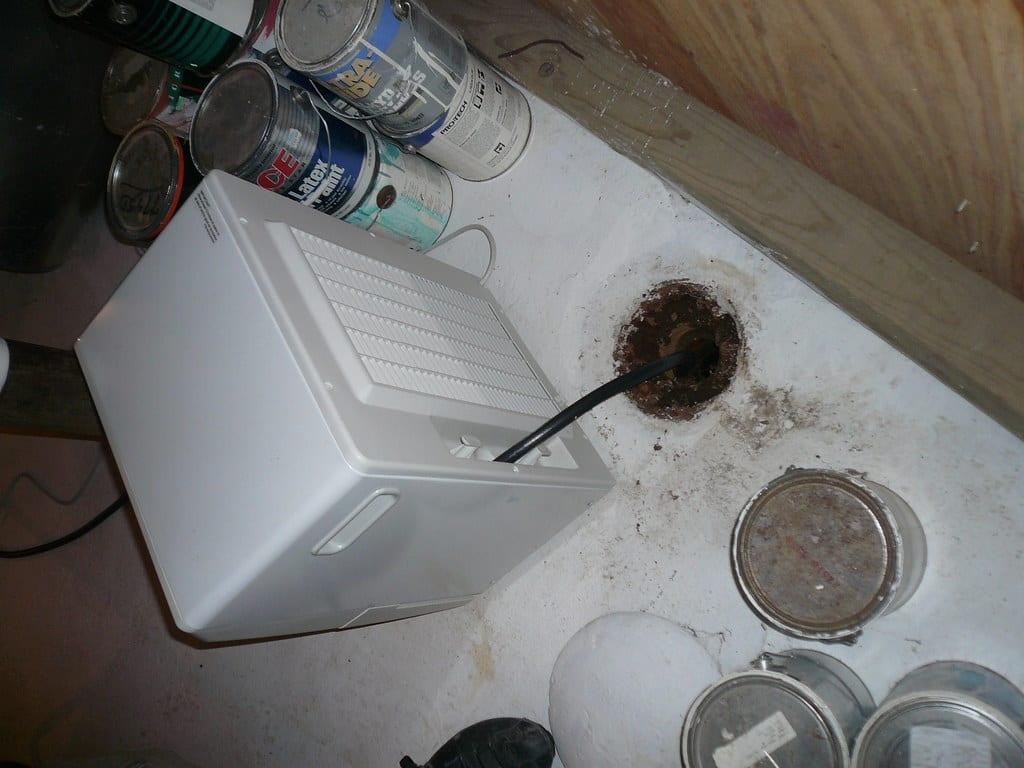 AprilAire E08080 pints a day over 4,400 sq ft, an ENERGY STAR Most Efficient rating, and a washable MERV 8 filter you are not buying cartridges for. | Most basements, ducted or standing | 9.0 | Check price on Amazon #ad we earn a commission · Amazon shows the current price |
| 2 |  AlorAir Sentinel HDi9090 pints a day at AHAM with a condensate pump inside the cabinet, running down to 34 F — the practical answer when the drain is the problem. | A basement with no floor drain | 8.9 | Check price on Amazon #ad we earn a commission · Amazon shows the current price |
| 3 | Santa Fe Compact7070 pints a day out of a 12 x 12 x 21 inch box with a MERV-13 filter and a rotatable outlet — the one that fits where nothing else will. | A crawl space or a tight mechanical room | 8.6 | Check price on Amazon #ad we earn a commission · Amazon shows the current price |
| 4 | AlorAir Sentinel HDi65S55 pints a day at AHAM over 1,300 sq ft, in a 44 lb cabinet with a pump that lifts nearly 20 feet and operation down to 34 F. | A smaller sealed space, with the pump included | 8.4 | Check price on Amazon #ad we earn a commission · Amazon shows the current price |
| 5 | AprilAire E100100 pints a day across 5,500 sq ft with 10 inch duct collars on both ends — the whole-house version of the E080 in the same cabinet. | A large house, ducted into the air handler | 8.8 | Check price on Amazon #ad we earn a commission · Amazon shows the current price |
Scores are ours and editorial, not lab measurements — see how we pick. Tap a row for the full write-up.
Built-in versus portable: what actually changes
A built-in unit is not a larger portable. Four things are genuinely different, and together they are the reason this class costs several times what a plug-in unit does.
- It is plumbed, not emptied. There is no bucket. The condensate goes to a drain by gravity or to a sink by pump, continuously, and the appliance never stops because nobody emptied it.
- It can be ducted. Returns and supplies let one unit treat a whole floor, or pull from a crawl space and discharge into conditioned space, rather than drying a ten-foot radius around itself.
- It keeps working when it is cold. The AlorAir units here run to 33.8 F and the Santa Fe to 49 F. Consumer portables typically frost their coils and stop somewhere around 60 F, which rules them out for exactly the shoulder seasons a basement is dampest in.
- It is sized by published capacity at a stated condition, not by a number on a box. AHAM, DOE and saturation ratings for the same machine can differ by a factor of four.
How we ranked them
- Published capacity at a stated condition. AHAM first, DOE alongside it where it exists. A headline pints-per-day figure with no condition attached does not count as data.
- Coverage against your actual square footage. Oversizing costs electricity and produces short cycles; undersizing means the unit never stops. Measure the floor before you shop.
- Drainage. A floor drain under the unit is the cheapest arrangement there is. No floor drain means a unit with a pump inside, or a separate condensate pump as part of the install.
- Minimum operating temperature. The figure that decides whether the appliance works in March. Anything that stops above 50 F is a summer appliance.
- Filtration and running cost. MERV rating, because basement air ends up upstairs; and kWh per year, because this machine runs for months at a stretch.
The published specifications, side by side
| AprilAire E080 | AlorAir HDi90 | Santa Fe Compact70 | AlorAir HDi65S | AprilAire E100 | |
|---|---|---|---|---|---|
| Headline capacity | 80 pints/day | 198 pints/day at saturation | 70 pints/day | 120 pints/day at saturation | 100 pints/day |
| AHAM / ENERGY STAR capacity | 65.0 pints/day (ENERGY STAR) | 90 pints/day (AHAM) | 70 pints/day at 80 F / 60% RH | 55 pints/day (AHAM) | 85.0 pints/day (ENERGY STAR) |
| Coverage | 4,400 sq ft | About 2,600 sq ft | 2,600 sq ft sealed / 1,800 loose | About 1,300 sq ft | 5,500 sq ft |
| Condensate pump | No — site over a drain | Yes, over 16 ft of lift | No | Yes, 19.6 ft of lift | No — site over a drain |
| Minimum operating temperature | Not published | 33.8 F | 49 F | 33.8 F | Not published |
| Filter | Washable MERV 8 | MERV-8 | MERV-13 | MERV-1 | Washable MERV 8 |
| Airflow | Not published | 210 CFM | 150 CFM at 0.0" WG | 130 CFM | Not published |
| Dimensions | 15 x 14 x 26 in | Not published | 12 x 12 x 21 in | 19.2 x 12.2 x 13.3 in | 15 x 14 x 26 in |
| Noise | Not published | Under 58 dB(A) | Not published | Under 52 dB(A) | Not published |
| Energy | 632 kWh/yr, 2.35 L/kWh | Not published | 444 W at 65 F / 60% RH | Not published | 821 kWh/yr, 2.35 L/kWh |
| Ducting | Ducted or free-standing | Ductable | Ductable, rotatable outlet | Ductable | 10 in inlet and outlet collars |
Read the first two rows together. The headline row and the comparable-capacity row describe the same five machines, and the ranking changes between them: on saturation ratings the AlorAir HDi90 looks like twice the appliance the AprilAire E080 is, and on comparable figures they are much closer. That gap is the single most common way a buyer in this category overpays for output they will not see.
AprilAire E080
80 pints a day over 4,400 sq ft, an ENERGY STAR Most Efficient rating, and a washable MERV 8 filter you are not buying cartridges for.
#ad we earn a commission · Amazon shows the current price
| Type | Whole-house dehumidifier, ducted or free-standing |
|---|---|
| Capacity | Removes up to 80 pints (10 gallons) per day |
| ENERGY STAR water removal | 65.0 pints/day |
| Coverage | Basements, sealed crawl spaces or whole homes up to 4,400 sq ft |
| Dimensions | 15 H x 14 W x 26 D in |
| Filter | Washable MERV 8, 13.5" x 12" nominal |
| Efficiency | 2.35 L/kWh integrated energy factor; 632 kWh/year |
| Certification | ENERGY STAR Most Efficient 2025 |
| Coils | Corrosion-resistant aluminum |
This is the unit that fits the largest number of basements without a conversation about edge cases. Eighty pints a day covers 4,400 square feet, which is more floor than most houses have below grade, and the efficiency figure is the strongest here: 2.35 liters per kilowatt-hour, 632 kWh a year, and an ENERGY STAR Most Efficient badge for 2025. A dehumidifier in a damp basement runs for months at a time, so the efficiency line is not a footnote — it is most of the running cost.
The specification worth noticing is the one nobody puts on the front of the box: it publishes both a headline capacity and an ENERGY STAR water-removal figure, 80 pints and 65.0 pints respectively. Those are not contradictory numbers, they are the same machine measured at different conditions, and a manufacturer printing both is telling you what you will actually get rather than only the best case. We rank on the published pair wherever one exists.
The washable MERV 8 filter is a quiet cost argument over a decade. Install flexibility is a louder one: the same cabinet can duct into the return side of the air handler to dry the whole house, or sit in the basement and treat that floor alone. Most houses change their mind about this once, usually after finishing the basement.
The honest gap is drainage. AprilAire's installation guidance is to place the unit over a drain, and there is no condensate pump in the cabinet. In a basement with a floor drain that is the simplest possible arrangement. In a basement without one, budget for a condensate pump as part of the job, or buy a unit with one built in.
What it gets right
- Removes up to 80 pints (10 gallons) a day, and publishes a 65.0 pints/day figure under the stricter ENERGY STAR test as well
- Rated for basements, sealed crawl spaces or whole homes up to 4,400 sq ft
- ENERGY STAR Most Efficient for 2025, at 2.35 L/kWh and 632 kWh a year
- Runs ducted into the house's air handler or free-standing in the basement, so one unit suits either plan
- Washable MERV 8 filter at a 13.5" x 12" nominal size — no proprietary cartridge to reorder
- Corrosion-resistant aluminum coils, which is the component a damp basement attacks first
Where it falls short
- No built-in condensate pump: AprilAire's own instruction is to place the unit over a drain, so a basement with no floor drain needs a separate pump
- AprilAire sells through its network of installing professionals rather than off a shelf, which usually means an installed price rather than a box price
- At 26 inches deep it is a substantial cabinet to site in a cramped mechanical room
- Does not publish a minimum operating temperature on the product page, where the AlorAir units publish 33.8 F
Specifications from AprilAire E080 product page, AprilAire E080 distributor listing (available, checked 2026-10-21), ENERGY STAR certified dehumidifier record.
AlorAir Sentinel HDi90
90 pints a day at AHAM with a condensate pump inside the cabinet, running down to 34 F — the practical answer when the drain is the problem.
#ad we earn a commission · Amazon shows the current price
| Type | Basement and crawl-space dehumidifier with a built-in condensate pump |
|---|---|
| Capacity | 90 pints/day at AHAM (80 F, 60% RH); 198 pints/day at saturation |
| DOE rating | 47.71 pints/day at DOE (60 F, 60% RH) |
| Coverage | Up to about 2,600 sq ft |
| Airflow | 210 CFM |
| Noise | Under 58 dB(A) |
| Pump lift | Pumps condensate over 16 ft of hose |
| Operating range | 33.8 to 104 F |
| Filter | MERV-8 |
The decision between this and the AprilAire is almost entirely about the drain. A whole-house dehumidifier produces several gallons of water a day in a basement that genuinely needs one, and that water has to leave by gravity or by pump. Units with the pump inside the cabinet remove an entire sub-project from the installation, and in a basement where the floor is the lowest point and there is no drain in it, that is the difference between a straightforward job and a plumbing conversation.
The low-temperature rating is the second argument and it is underrated. Basements are coldest and dampest in the shoulder seasons, and a dehumidifier that frosts its coil and stops at 50 F is unavailable for a large part of the year it was bought for. Operation down to 33.8 F means the appliance works in March and October, not only in July.
Read the capacity figures carefully, because this is where the whole category is slippery. AHAM is measured at 80 F and 60% relative humidity, saturation at 90 F and 90%, and DOE at a cooler, drier condition that produces a much smaller number. All three are on the sheet for this unit — 90, 198 and 47.71 pints a day. The marketing number is 198. The one to plan around is 90.
What it gets right
- 90 pints/day at AHAM and 198 pints/day at saturation, with a 47.71 pints/day DOE figure published alongside
- Built-in condensate pump lifts over 16 ft of hose, so a laundry sink or a window is a valid destination
- Operates down to 33.8 F, where consumer portables frost up and shut off — which is exactly the spring and fall weather a basement is damp in
- Covers roughly 2,600 sq ft with a MERV-8 filter
- Under 58 dB(A), which is reasonable for a unit of this output
Where it falls short
- Publishes three different capacity figures (AHAM, saturation and DOE) and the saturation number is the one marketing leans on — read the AHAM figure
- Physically large, and 58 dB is audible in a finished basement
- Costs considerably more than a consumer portable of nominally similar capacity
- Not an ENERGY STAR Most Efficient unit; the AprilAire E080 is the stronger buy on running cost alone
Specifications from AlorAir Sentinel HDi90 specification listing, AlorAir Sentinel HDi90 retail listing.
Santa Fe Compact70
70 pints a day out of a 12 x 12 x 21 inch box with a MERV-13 filter and a rotatable outlet — the one that fits where nothing else will.
#ad we earn a commission · Amazon shows the current price
| Type | Ductable crawl-space and basement dehumidifier |
|---|---|
| Capacity | 70 pints/day at 80 F and 60% RH |
| Coverage | Up to 2,600 sq ft tightly sealed; 1,800 sq ft loosely sealed |
| Dimensions | 12 W x 12 H x 21 D in |
| Airflow | 150 CFM at 0.0" WG |
| Electrical | 115 V, 1 phase, 3.7 A and 444 W at 65 F / 60% RH |
| Operating range | 49 F minimum, 95 F maximum |
| Filter | MERV-13 |
| Outlet | Rotatable exhaust for horizontal or vertical discharge |
Specification sheets rarely decide a purchase; dimensions frequently do. A crawl space with 30 inches of headroom and a hatch you have to crab through does not care that a 26 inch deep cabinet is more efficient. At 12 x 12 x 21 inches this is the unit that physically fits, and it still removes 70 pints a day at 80 F and 60% RH.
The MERV-13 filter is the other genuine differentiator. Crawl spaces and old basements push soil gas, mold spores and fine dust into the air that the rest of the house then breathes, because stack effect pulls that air upward. A MERV-13 element captures a meaningfully finer particle than the MERV-8 filters in the two units above it, and the air it processes is going upstairs whether you like it or not. The encapsulation case is in encapsulation vs vapor barrier.
The 49 F floor is the number that rules it in or out. In a sealed and insulated crawl space, or a conditioned basement, the space never gets there and the limit is academic. In a vented crawl space in a cold climate it is a serious constraint, and it is one more reason to seal the space before buying the appliance that has to work in it.
What it gets right
- 12 W x 12 H x 21 D inches, far smaller than any other unit here and the reason it fits a crawl space
- MERV-13 filter, the finest filtration in this group by a wide margin
- Rotatable exhaust outlet for horizontal or vertical discharge, plus ducting options for divided spaces
- Covers up to 2,600 sq ft in a tightly sealed crawl space, 1,800 sq ft loosely sealed
- Published electrical figures at a stated condition: 3.7 A and 444 W at 65 F and 60% RH
Where it falls short
- 49 F minimum operating temperature — the worst cold-weather figure here, and a real limitation in an unheated crawl space in winter
- 150 CFM of airflow, which is modest for the coverage claimed
- No condensate pump in the unit; drainage is gravity unless you add one
- The most expensive way to remove 70 pints a day in this roundup
Specifications from Santa Fe Compact70 (4044110) specification listing, Santa Fe Compact70 retail listing (available, checked 2026-10-21).
AlorAir Sentinel HDi65S
55 pints a day at AHAM over 1,300 sq ft, in a 44 lb cabinet with a pump that lifts nearly 20 feet and operation down to 34 F.
#ad we earn a commission · Amazon shows the current price
| Type | Ductable basement and crawl-space dehumidifier with a built-in condensate pump |
|---|---|
| Capacity | 55 pints/day at AHAM (80 F, 60% RH); 120 pints/day at saturation (90 F, 90% RH) |
| Coverage | Up to about 1,300 sq ft |
| Airflow | 130 CFM |
| Dimensions | 19.2 x 12.2 x 13.3 in |
| Weight | Listings disagree: 44 lb on one retailer, 57.3 lb on the AlorAir store |
| Electrical | 115 V, 60 Hz |
| Efficiency | 2.4 L/kWh |
| Operating range | 33.8 to 104 F; 36% to 90% RH |
| Refrigerant | R410A |
| Condensate | Built-in pump lifting 19.6 ft, or gravity drain to 6.5 ft |
| Noise | Under 52 dB(A) |
| Filter | MERV-1 supplied; a MERV-8 filter is also listed for the unit |
| Wi-Fi | Only on the Wi-Fi variant, which controls and monitors through the AlorAir-C app |
| Warranty | Stated inconsistently — see the review page |
This is the right-sized version of the HDi90 above, and in a basement under about 1,300 square feet it is the better buy for the straightforward reason that a dehumidifier sized well above its space short cycles, which is as hard on a compressor as it is on a pump motor.
Two numbers stand out. The 19.6 foot pump lift is the highest here and solves the awkward case — a basement where the only drain is a laundry sink at the far end, up a flight. And under 52 dB(A) makes it the quietest unit in this roundup, which matters if the mechanical room shares a wall with a bedroom or an office.
The MERV-1 filter is a real weakness and we are not going to soften it. It keeps lint and debris off the coil and does essentially nothing for air quality. If the reason you are installing a dehumidifier is partly that the basement smells, filtration is part of the answer and this unit does not provide it.
What it gets right
- 55 pints/day at AHAM, 120 pints/day at saturation, for a space up to about 1,300 sq ft
- Built-in pump lifting 19.6 ft, the highest lift here, or gravity drain to 6.5 ft
- Runs from 33.8 F to 104 F, matching the larger HDi90 on cold-weather operation
- Under 52 dB(A) — the quietest unit in this roundup
- 19.2 x 12.2 x 13.3 in and 44 lb, so one person can site it
- Five-year compressor warranty, three years on the coil
Where it falls short
- MERV-1 filter, which is a debris screen rather than air filtration — the Santa Fe's MERV-13 is in a different league
- 1,300 sq ft of coverage is the smallest here; a large basement will leave it running continuously
- Only one year of parts and labor warranty, against five years on the compressor alone
- Published electrical data stops at 115 V and 60 Hz — no amps or watts on the listing we cite
Specifications from AlorAir Sentinel HDi65S retail listing and specification (in stock, checked 2026-10-21), AlorAir store listing: in stock, 130 CFM, 19.6 ft pump lift, 57.3 lb, R410A, 2.4 L/kWh, 36-90% RH (checked 2026-11-04), AlorAir Sentinel HDi65S distributor specification.
AprilAire E100
100 pints a day across 5,500 sq ft with 10 inch duct collars on both ends — the whole-house version of the E080 in the same cabinet.
#ad we earn a commission · Amazon shows the current price
| Type | Whole-house dehumidifier, ducted or free-standing |
|---|---|
| Capacity | Removes up to 100 pints (12.5 gallons) per day |
| ENERGY STAR water removal | 85.0 pints/day |
| Coverage | Basements, sealed crawl spaces or whole homes up to 5,500 sq ft |
| Dimensions | 15 H x 14 W x 26 D in |
| Duct collars | 10 in inlet and 10 in outlet |
| Filter | Washable MERV 8, 13.5" x 12" nominal |
| Efficiency | 2.35 L/kWh integrated energy factor; 821 kWh/year |
This is the unit for the house rather than for the basement. Ducted into the return side of an air handler with 10 inch collars at both ends, it dries 5,500 square feet of conditioned space, which covers most whole-house applications outside the genuinely large.
Size it honestly. The temptation in this category is to buy the bigger number, and the penalty is real: 821 kWh a year against 632 for the E080, for capacity a single damp basement cannot use. Oversizing also produces shorter run cycles, and a dehumidifier removes moisture most effectively when it runs steadily rather than in bursts.
What it gets right
- Removes up to 100 pints (12.5 gallons) a day, with an 85.0 pints/day ENERGY STAR water-removal figure published alongside
- Rated to 5,500 sq ft, the largest coverage in this roundup
- 10 inch inlet and outlet duct collars, so it integrates properly with a ducted system rather than being adapted into one
- Same 15 x 14 x 26 in cabinet and washable MERV 8 filter as the E080
- 2.35 L/kWh integrated energy factor, matching the smaller unit's efficiency at higher output
Where it falls short
- 821 kWh a year against the E080's 632 — more capacity costs more to run, and an oversized unit in a small basement wastes the difference
- No condensate pump, same as the E080: the unit is designed to sit over a drain
- Only worth the step up if the square footage or the duct run genuinely calls for it
- Sold through installing professionals, so it is a quoted job rather than a cart
Specifications from AprilAire E100 product page, AprilAire E100 distributor listing (available, checked 2026-10-21), ENERGY STAR certified dehumidifier record.
What humidity should a basement actually sit at?
The EPA's guidance is to keep indoor humidity below 60 percent relative humidity, and ideally between 30 and 50 percent. That range is the setpoint to dial in, not a number to beat — running a basement at 35 percent costs electricity and achieves nothing a reading of 50 does not. Our detailed treatment, including why a reading of 65 percent in a cool basement is a different problem from 65 percent upstairs, is in basement humidity level.
Buy a hygrometer before you buy the dehumidifier. A two-week log of actual readings in the space, taken at different times of day, tells you whether you have a 55-percent nuisance or a 75-percent problem, and the answer changes which unit on this page is the right one — or whether you need one at all.
Installation: the parts people forget
- Decide the drain first. Gravity to a floor drain is the cheapest and most reliable arrangement. A pump — internal or external — is the alternative, and it adds a component that can fail quietly. Either way, run the line so a blockage overflows somewhere you will notice.
- Give the unit clearance. These cabinets pull air in one end and push it out the other. Pushed into a corner, a 4,400 sq ft unit treats one corner.
- Seal the space before you buy the machine. A dehumidifier drying an unsealed crawl space is dehumidifying the outdoors. Crawl space encapsulation kits covers the groundwork, and the best vapor barriers covers the floor.
- Put it on its own circuit if you can. A unit running for months alongside a sump pump on a shared circuit is a nuisance trip waiting for the wrong night.
- Keep the sump pit covered. An open pit is a continuous evaporation surface feeding the air the dehumidifier is paying to dry — see sump pump covers.
Questions people ask
What is the best built-in dehumidifier for a basement?
The AprilAire E080. It removes up to 80 pints a day across 4,400 sq ft, publishes a 65.0 pints/day ENERGY STAR water-removal figure alongside that headline, carries an ENERGY STAR Most Efficient 2025 rating at 632 kWh a year, uses a washable MERV 8 filter, and installs either ducted or free-standing. Its one real limitation is drainage: there is no condensate pump in the cabinet, so it needs a floor drain or a separate pump.
Is a whole-house dehumidifier worth it for a basement?
It is worth it when the basement is damp for months rather than days, when there is no floor-level convenience in emptying a bucket, or when the air from the basement is reaching the rest of the house. It is not worth it if water is physically entering through walls or the cove joint — that is a drainage and waterproofing problem, and a dehumidifier will run continuously without solving it.
Do built-in dehumidifiers need a drain?
They need somewhere for the condensate to go, continuously. A floor drain under the unit is the simplest and most reliable arrangement. Where there is no drain, buy a unit with a built-in condensate pump — the AlorAir Sentinel HDi90 lifts over 16 ft and the HDi65S nearly 20 ft — or budget for a separate condensate pump as part of the installation.
What size dehumidifier do I need for a basement?
Match published coverage to the actual square footage of the space, and compare capacities measured the same way. The units here cover roughly 1,300 sq ft (AlorAir HDi65S), 2,600 sq ft (AlorAir HDi90 and Santa Fe Compact70 sealed), 4,400 sq ft (AprilAire E080) and 5,500 sq ft (AprilAire E100). Oversizing wastes electricity and produces short cycles; undersizing means the unit never stops.
Why do capacity numbers vary so much between brands?
Because they are measured at different conditions. A saturation rating is taken at 90 F and 90% relative humidity, an AHAM rating at 80 F and 60%, and a DOE rating at a cooler and drier condition again. The AlorAir Sentinel HDi90 publishes 198, 90 and 47.71 pints a day for the same machine. Compare AHAM to AHAM, and treat a brand that publishes only the saturation figure accordingly.
Will a dehumidifier stop my basement flooding?
No. A dehumidifier removes water vapor from air. It has no effect on liquid water entering through a wall crack, the cove joint, a window well or a failed sump pump, and it cannot keep up with any of them. Dry the air after the water is handled, not instead.
Sources
- AprilAire E080 product page
- AprilAire E100 product page
- ENERGY STAR certified dehumidifier record (E080)
- ENERGY STAR certified dehumidifier record (E100)
- Santa Fe Compact70 (4044110) specification listing
- AlorAir Sentinel HDi65S retail listing and specification
- AlorAir Sentinel HDi90 specification listing
- EPA — keep indoor humidity below 60 percent, ideally 30 to 50 percent
Read next
The best basement dehumidifiers with a pump
A dehumidifier manages the moisture already in the air. It does nothing about where that moisture is coming from — which is a feature, not a criticism, as long as you know it.
The best crawl space dehumidifiers
Nobody empties a bucket under a house. In a crawl space the condensate pump is not a convenience feature, it is the feature.
What basement humidity level is safe?
One number answers most of this question, and the number is lower than most basements ever reach on their own.
How to waterproof a basement
Start outside. A startling share of wet basements are fixed with a ladder and an afternoon, and no product at all.
The best crawl space encapsulation kits
Good value for the materials, and consistently missing the three things that decide whether encapsulation works.
The best sump pit covers
An open pit is an evaporation surface in the middle of your basement. A lid is the cheapest humidity fix there is.