AlorAir Sentinel HDi65S review
The crawl-space dehumidifier everyone recommends, sold on a 120-pint number that describes a day your crawl space will never have. Here is what it actually removes.
We earn a commission if you buy through our Amazon links, at no cost to you. We do not bench-test these products and we never take free product — how we pick · affiliate disclosure
Verdict: the AlorAir Sentinel HDi65S is worth buying if your crawl space has no drain, no pit and no fall to work with — the internal condensate pump is the feature, and it is a good one. Size it on 55 pints a day at AHAM, not on the 120 printed in the product name, and expect to buy a better filter than the MERV-1 in the box. If you have a floor drain, an ENERGY STAR unit like the AprilAire E080 gives you a certified capacity figure and a consistent warranty for a similar outlay.
This page exists because the HDi65S is the unit that comes up in every crawl space thread and almost nobody explains the capacity numbers. Everything below is taken from the manufacturer's and retailers' published specifications, including the places where they contradict each other.
Quick picks
| # | Product | Best for | Score | Price |
|---|---|---|---|---|
| 1 | 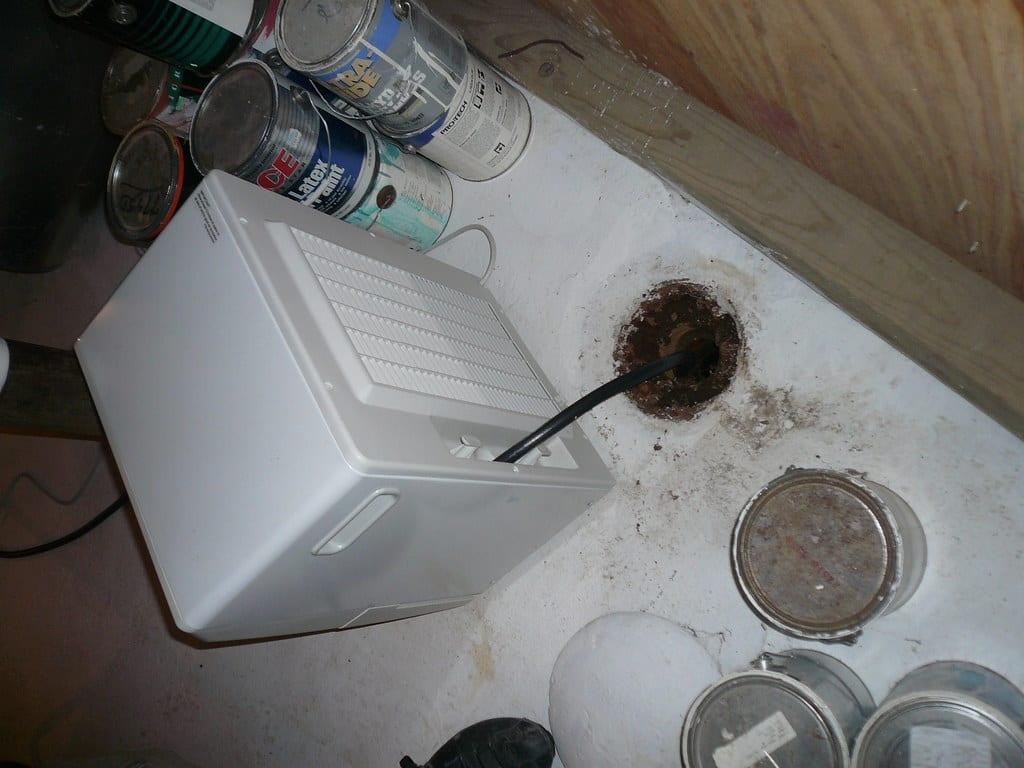 AlorAir Sentinel HDi65S55 pints a day at AHAM conditions out of a 19 inch box that fits between joists, with an internal pump that lifts condensate nearly twenty feet — which is the feature you are actually paying for. | A sealed crawl space with nowhere for water to drain | 8.5 | Check price on Amazon #ad we earn a commission · Amazon shows the current price |
| 2 |  AlorAir Sentinel HDi90The same idea one size up: 90 pints at AHAM, 210 CFM and a MERV-8 filter as standard, for a space the HDi65S would run continuously in. | A crawl space or basement over about 1,300 square feet | 8.6 | Check price on Amazon #ad we earn a commission · Amazon shows the current price |
| 3 | Santa Fe Compact7070 pints a day at 80 F and 60% RH behind a MERV-13 filter, in the narrowest footprint here — but it stops working at 49 F and has no internal pump. | Filtration and build, in a crawl space that does not freeze | 8.2 | Check price on Amazon #ad we earn a commission · Amazon shows the current price |
| 4 | AprilAire E080An ENERGY STAR Most Efficient unit with a government-verified 65 pints a day of water removal, for a basement or sealed crawl space with somewhere to drain. | A certified capacity figure and a drain you already have | 8.4 | Check price on Amazon #ad we earn a commission · Amazon shows the current price |
Scores are ours and editorial, not lab measurements — see how we pick. Tap a row for the full write-up.
The three capacity numbers, and which one to use
Dehumidifier capacity is quoted under three different test conditions, and the industry quotes whichever one flatters the product. This is the single most useful thing to understand before spending several hundred dollars.
| Rating | Test condition | What it means | HDi65S figure |
|---|---|---|---|
| Saturation | 90 F, 90% relative humidity | A tropical greenhouse. Produces the biggest number, which is why it goes on the box. | 120 pints/day |
| AHAM | 80 F, 60% relative humidity | A warm, humid summer day. The right figure for sizing a basement or a sealed crawl space. | 55 pints/day |
| DOE | 60 F, 60% relative humidity | A cool crawl space. The most conservative figure, and the one almost nobody publishes. | Not published for this model |
AlorAir publishes saturation and AHAM for the HDi65S, and publishes a DOE figure for the larger HDi90 (47.71 pints a day) but not for this one. AprilAire publishes an ENERGY STAR verified water-removal rate instead. Santa Fe publishes at 80 F and 60% RH. When you line those up, the honest comparison is 55 against 65 against 70 — not 120 against anything.
What the published specifications actually say
| AlorAir HDi65S | AlorAir HDi90 | Santa Fe Compact70 | AprilAire E080 | |
|---|---|---|---|---|
| Capacity (real test) | 55 pints/day AHAM | 90 pints/day AHAM | 70 pints/day at 80 F / 60% RH | 65.0 pints/day ENERGY STAR verified |
| Headline capacity | 120 pints/day saturation | 198 pints/day saturation | 70 pints/day | 80 pints/day |
| Coverage | Up to 1,300 sq ft | Up to 2,600 sq ft | 2,600 sq ft sealed / 1,800 loose | Up to 4,400 sq ft |
| Airflow | 130 CFM | 210 CFM | 150 CFM at 0.0" WG | Not published |
| Internal pump | Yes, 19.6 ft lift | Yes, over 16 ft of hose | No | No — site it over a drain |
| Minimum temperature | 33.8 F | 33.8 F | 49 F | Not published |
| Filter | MERV-1 supplied | MERV-8 | MERV-13 | Washable MERV 8 |
| Dimensions | 19.2 x 12.2 x 13.3 in | Not published | 12 W x 12 H x 21 D in | 15 H x 14 W x 26 D in |
| Noise | Under 52 dB(A) | Under 58 dB(A) | Not published | Not published |
| Efficiency | 2.4 L/kWh | Not published | 444 W at 65 F / 60% RH | 2.35 L/kWh, 632 kWh/year |
| Warranty | Published three ways | Not published | Not published | Five years |
AlorAir Sentinel HDi65S
55 pints a day at AHAM conditions out of a 19 inch box that fits between joists, with an internal pump that lifts condensate nearly twenty feet — which is the feature you are actually paying for.
#ad we earn a commission · Amazon shows the current price
| Type | Ductable basement and crawl-space dehumidifier with a built-in condensate pump |
|---|---|
| Capacity | 55 pints/day at AHAM (80 F, 60% RH); 120 pints/day at saturation (90 F, 90% RH) |
| Coverage | Up to about 1,300 sq ft |
| Airflow | 130 CFM |
| Dimensions | 19.2 x 12.2 x 13.3 in |
| Weight | Listings disagree: 44 lb on one retailer, 57.3 lb on the AlorAir store |
| Electrical | 115 V, 60 Hz |
| Efficiency | 2.4 L/kWh |
| Operating range | 33.8 to 104 F; 36% to 90% RH |
| Refrigerant | R410A |
| Condensate | Built-in pump lifting 19.6 ft, or gravity drain to 6.5 ft |
| Noise | Under 52 dB(A) |
| Filter | MERV-1 supplied; a MERV-8 filter is also listed for the unit |
| Wi-Fi | Only on the Wi-Fi variant, which controls and monitors through the AlorAir-C app |
| Warranty | Stated inconsistently — see the review page |
Start with the number on the box, because it is the reason this review exists. AlorAir sells the HDi65S as a 120 pints-per-day dehumidifier. That figure is measured at saturation — 90 degrees Fahrenheit and 90 percent relative humidity — which is a condition your crawl space will not see. The figure measured at AHAM conditions, 80 F and 60% RH, is 55 pints a day. Both numbers are honestly printed on the specification; only one of them describes a crawl space, and it is less than half the size of the one in the product name.
That is not a reason to avoid the unit. It is a reason to size on 55. A sealed crawl space of 1,000 to 1,300 square feet with a vapor barrier down is removing a steady trickle of moisture, not a flood, and 55 pints a day of capacity is a lot of headroom for that job. What it means is that you cannot compare this unit against an 80-pint AprilAire by reading the two names — one is quoting saturation and the other is quoting a government test. The comparison is laid out in AlorAir vs AprilAire.
The feature that actually justifies the price is the pump. Crawl spaces are the worst place in a house to drain anything: there is no floor drain, often no pit, and no fall to work with. A condensate pump rated to lift 19.6 feet means the unit can sit on the dirt and push its water up through the rim joist and out to grade through a small-diameter hose. Without it you are either digging a pit, running a long gravity line and hoping, or emptying a bucket in a space you have to crawl into. Nothing else on the spec sheet changes the install as much as this does.
The physical size is the second real argument. At 19.2 by 12.2 by 13.3 inches this fits where a portable dehumidifier simply does not, and the ductable outlet lets you push dry air toward the far end of a long crawl space rather than treating the three feet around the unit. The 33.8 F lower operating limit matters too: a crawl space in February is cold, and most consumer dehumidifiers either frost over or shut themselves off long before that.
Three things are genuinely annoying about buying this unit, and they are all about information rather than hardware. The weight is published as 44 pounds by one retailer and 57.3 pounds by AlorAir's own store, which is a thirty percent spread on an object you may have to drag through a hatch. The warranty is published three different ways across three sellers. And the filter that comes in the box is MERV-1, which is a screen, in the dustiest room in the house. Budget for the MERV-8 filter and treat the warranty as whatever the seller you actually buy from will put in writing.
One thing to be clear about: a dehumidifier is the last step in a crawl space, not the first. If water is coming in, a dehumidifier runs continuously and loses. Bulk water first, ground cover second, humidity third — that order is set out in encapsulation vs vapor barrier, and the humidity target to aim for is in basement humidity level.
What it gets right
- Built-in condensate pump rated to lift 19.6 ft, so the unit can sit on the crawl space floor and still push water up and out to grade without a pit or a gravity fall
- 19.2 x 12.2 x 13.3 in, small enough to slide between joists or sit under a low crawl space ceiling where a free-standing dehumidifier cannot go
- Operating range down to 33.8 F, which matters in a vented or partly vented crawl space in a northern winter; most portable dehumidifiers frost up and quit well above that
- 130 CFM and a ductable outlet, so one unit can be aimed at a far corner instead of drying the air immediately around it
- 2.4 L/kWh stated efficiency, which is in the same territory as the ducted whole-house units that cost considerably more
- Gravity-drain option if you do have a floor drain, so the pump is a convenience rather than a single point of failure
- In stock and shipping from AlorAir's own store when we checked on 4 November 2026
Where it falls short
- The headline 120 pints per day is a saturation figure measured at 90 F and 90% relative humidity. Your crawl space is not 90 F at 90% RH. The number that describes real use is 55 pints a day at AHAM conditions, and it is less than half the number on the box
- The supplied filter is MERV-1 — effectively a coarse screen. A crawl space is a dusty place and MERV-1 is the weakest filtration of any unit we compare it against
- Published weight disagrees badly between sellers: 44 lb on one retailer, 57.3 lb on AlorAir's own store. That is a thirty percent difference on a unit you may be carrying through a 24 inch access hatch, alone, on your back
- The warranty is published three different ways — six years limited with the first two fully covered on the AlorAir store, five years elsewhere, and a one-year performance guarantee on a third listing. We cannot tell you which one you get
- Wi-Fi is only on the Wi-Fi variant. Buying the cheaper model and expecting app monitoring is a mistake several buyers appear to make
- No ENERGY STAR certification, where both AprilAire units we compare it against carry one and publish a government-verified water-removal figure
Specifications from AlorAir Sentinel HDi65S retail listing and specification (in stock, checked 2026-10-21), AlorAir store listing: in stock, 130 CFM, 19.6 ft pump lift, 57.3 lb, R410A, 2.4 L/kWh, 36-90% RH (checked 2026-11-04), AlorAir Sentinel HDi65S distributor specification.
AlorAir Sentinel HDi90
The same idea one size up: 90 pints at AHAM, 210 CFM and a MERV-8 filter as standard, for a space the HDi65S would run continuously in.
#ad we earn a commission · Amazon shows the current price
| Type | Basement and crawl-space dehumidifier with a built-in condensate pump |
|---|---|
| Capacity | 90 pints/day at AHAM (80 F, 60% RH); 198 pints/day at saturation |
| DOE rating | 47.71 pints/day at DOE (60 F, 60% RH) |
| Coverage | Up to about 2,600 sq ft |
| Airflow | 210 CFM |
| Noise | Under 58 dB(A) |
| Pump lift | Pumps condensate over 16 ft of hose |
| Operating range | 33.8 to 104 F |
| Filter | MERV-8 |
The honest upgrade, and the deciding number is square footage rather than ambition. Up to about 1,300 square feet the HDi65S is the right unit; past that it will run most of the day to hold a setpoint it should be reaching in a few hours, and running most of the day is how a compressor ages.
Two specifics are worth weighing beyond capacity. The HDi90 ships with a MERV-8 filter where the smaller unit ships with MERV-1, which in a dirt crawl space is a real difference in what reaches the coil. And it publishes a DOE figure — 47.71 pints a day at 60 F and 60% RH — which is the coldest, most pessimistic and most honest of the three standard test conditions, and the one nobody prints on a box.
What it gets right
- 90 pints a day at AHAM — a genuine step up rather than a bigger saturation number
- Coverage to about 2,600 sq ft, double the HDi65S
- 210 CFM, so it can actually move air the length of a large crawl space
- MERV-8 filter as standard rather than the HDi65S's MERV-1
- Same 33.8 to 104 F operating range, and a condensate pump rated over 16 ft of hose
- A DOE rating is published (47.71 pints/day at 60 F, 60% RH), which is the most conservative and most useful of the three test conditions
Where it falls short
- Under 58 dB(A) against the HDi65S's under 52 — noticeably louder, which matters if the crawl space sits under a bedroom
- The pump is specified as lifting over 16 ft of hose rather than the HDi65S's 19.6 ft figure, so read the install height before assuming the bigger unit also reaches further
- Physically larger, which can be the whole problem in a crawl space with a small hatch
- Same brand-level complaint: the headline is a 198 pints-per-day saturation figure
- Oversizing a dehumidifier makes it short-cycle, which dries the air unevenly and wears the compressor
Specifications from AlorAir Sentinel HDi90 specification listing, AlorAir Sentinel HDi90 retail listing.
Santa Fe Compact70
70 pints a day at 80 F and 60% RH behind a MERV-13 filter, in the narrowest footprint here — but it stops working at 49 F and has no internal pump.
#ad we earn a commission · Amazon shows the current price
| Type | Ductable crawl-space and basement dehumidifier |
|---|---|
| Capacity | 70 pints/day at 80 F and 60% RH |
| Coverage | Up to 2,600 sq ft tightly sealed; 1,800 sq ft loosely sealed |
| Dimensions | 12 W x 12 H x 21 D in |
| Airflow | 150 CFM at 0.0" WG |
| Electrical | 115 V, 1 phase, 3.7 A and 444 W at 65 F / 60% RH |
| Operating range | 49 F minimum, 95 F maximum |
| Filter | MERV-13 |
| Outlet | Rotatable exhaust for horizontal or vertical discharge |
If the crawl space is sealed, conditioned and in a mild climate, this is arguably the better machine. MERV-13 filtration in a dirt crawl space is not a luxury — it is the difference between a coil that stays clean and one that is furred over in three years — and Santa Fe publishes a complete electrical specification instead of a marketing figure.
Two things rule it out for a lot of buyers, and both are structural rather than matters of taste. It stops at 49 F, which removes it from any crawl space that gets properly cold. And there is no internal pump, so unless you have somewhere for the water to fall to, you are buying a second device to move it. For a sealed crawl space in a warm state it is excellent; for a vented crawl space in Minnesota it is the wrong tool.
What it gets right
- MERV-13 filtration, far beyond anything else on this page, which in a crawl space is about mold spores and dust rather than comfort
- 12 W x 12 H x 21 D in — the narrowest unit here, and it can be ducted with a rotatable outlet for horizontal or vertical discharge
- 70 pints a day quoted at 80 F and 60% RH, a real test condition rather than a saturation headline
- Full electrical specification published: 115 V, 3.7 A and 444 W at 65 F and 60% RH, so you can work out the running cost before you buy
- Coverage to 2,600 sq ft tightly sealed, 1,800 sq ft loosely sealed — and publishing both of those numbers is unusually honest
Where it falls short
- 49 F minimum operating temperature. In a vented crawl space in a cold climate this unit is out of service for part of the year, where the AlorAir units run to 33.8 F
- No internal condensate pump in this configuration, so you need a gravity drain or a separate pump — which is exactly the problem the HDi65S solves
- Usually the most expensive unit on this page
- 150 CFM is modest for the square footage it claims; a long crawl space will want ducting rather than a bare outlet
Specifications from Santa Fe Compact70 (4044110) specification listing, Santa Fe Compact70 retail listing (available, checked 2026-10-21).
AprilAire E080
An ENERGY STAR Most Efficient unit with a government-verified 65 pints a day of water removal, for a basement or sealed crawl space with somewhere to drain.
#ad we earn a commission · Amazon shows the current price
| Type | Whole-house dehumidifier, ducted or free-standing |
|---|---|
| Capacity | Removes up to 80 pints (10 gallons) per day |
| ENERGY STAR water removal | 65.0 pints/day |
| Coverage | Basements, sealed crawl spaces or whole homes up to 4,400 sq ft |
| Dimensions | 15 H x 14 W x 26 D in |
| Filter | Washable MERV 8, 13.5" x 12" nominal |
| Efficiency | 2.35 L/kWh integrated energy factor; 632 kWh/year |
| Certification | ENERGY STAR Most Efficient 2025 |
| Coils | Corrosion-resistant aluminum |
This is the unit to weigh the HDi65S against, and the comparison is less about capacity than about who is doing the measuring. AprilAire's 80-pint model is certified by ENERGY STAR at 65.0 pints a day of water removal — a figure produced by a standard test and published in a government database, not by the manufacturer's marketing department. AlorAir's 55 pints at AHAM is also a real test condition, and it is the right number to compare against 65. The 120 on the box is not.
Where it loses for crawl spaces is drainage and shape. There is no internal pump, and AprilAire's installation guidance is to site the unit over a drain. In a basement with a floor drain that is perfectly sensible. In a crawl space with a dirt floor it means buying and plumbing a condensate pump separately, which is the job the HDi65S does in the box. The full head-to-head is in AlorAir vs AprilAire.
What it gets right
- ENERGY STAR certified with a verified water-removal rating of 65.0 pints/day — an independently tested number rather than a manufacturer's
- 2.35 L/kWh integrated energy factor and 632 kWh/year, both from the ENERGY STAR record, so annual running cost is calculable
- ENERGY STAR Most Efficient 2025
- Washable MERV 8 filter, corrosion-resistant aluminum coils
- Ducted or free-standing, covering basements and sealed crawl spaces up to 4,400 sq ft
- Five-year warranty, stated consistently by the manufacturer and its distributors — which is more than AlorAir manages
Where it falls short
- No internal condensate pump: AprilAire's own guidance is to place it over a drain, which a crawl space usually does not have
- 15 H x 14 W x 26 D in — longer than the AlorAir units and awkward in a low crawl space
- Sold mainly through HVAC distribution rather than consumer retail, so it is a trade order rather than a next-day delivery
- Costs substantially more than the HDi65S before you add the pump you will still need
Specifications from AprilAire E080 product page, AprilAire E080 distributor listing (available, checked 2026-10-21), ENERGY STAR certified dehumidifier record.
Who the HDi65S is actually for
- A sealed crawl space under about 1,300 square feet with no drain. This is the case the unit is built for, and nothing else here solves the drainage problem in the box.
- A crawl space that gets genuinely cold. 33.8 F of operating range keeps it working through a northern winter where the Santa Fe has stopped at 49 F.
- A tight hatch. At roughly 19 inches long it goes through openings the AprilAire does not.
- A basement corner with no floor drain. The same pump argument applies in a basement; see the best basement dehumidifiers with a pump.
And who should buy something else
- You have a floor drain or a sump pit. The pump is most of the price premium. Without needing it, an ENERGY STAR unit gives you a certified number and a warranty everyone agrees on.
- Your space is over about 1,300 square feet. Step up to the HDi90 rather than letting a smaller unit run all day.
- Water is still getting in. A dehumidifier cannot out-run a leak. Fix bulk water first — does a crawl space need a sump pump is the place to start.
- There is no vapor barrier down yet. Running a dehumidifier over open dirt is dehumidifying the soil, which is an unwinnable contest. The best crawl space vapor barriers comes first.
Living with it
Set the humidistat to 50 to 55 percent and leave it there. Chasing a lower number makes the compressor run far more for a benefit nobody can feel, and the EPA's guidance is to keep indoor humidity below 60 percent, ideally between 30 and 50. There is no prize for 35 percent in a crawl space.
Check the filter quarterly for the first year, then settle into whatever interval that teaches you. A crawl space is dustier than any room in the house and the supplied MERV-1 screen is not catching much of it, so the dust it misses is landing on the coil instead. Check the pump's discharge hose at the same time — a condensate line that has been pinched by something stored against it is the most common way one of these units quietly stops working.
And watch where the pump discharges. Nineteen feet of lift is plenty to get water out through the rim joist, but putting it out at the foundation is simply recycling it back through the footing drain. Discharge away from the house, the same rule that applies to a sump pump — where to discharge sump pump water covers the distances.
Questions people ask
Is the AlorAir Sentinel HDi65S worth it?
Yes, for a sealed crawl space under about 1,300 square feet with no floor drain and no pit. The internal condensate pump lifting 19.6 feet is what you are paying for, and it removes the hardest part of a crawl space install. If you already have a drain, an ENERGY STAR unit such as the AprilAire E080 gives you a government-verified capacity figure and a warranty everyone states the same way.
Does the HDi65S really remove 120 pints a day?
Only at 90 degrees Fahrenheit and 90 percent relative humidity, which is the saturation test condition and not a condition your crawl space will see. At AHAM conditions — 80 F and 60% RH — it is rated at 55 pints a day. Size on 55.
What size crawl space does the HDi65S cover?
AlorAir rates it to about 1,300 square feet. Past that, the HDi90 covers roughly 2,600 square feet at 90 pints a day AHAM with 210 CFM of airflow, and it ships with a MERV-8 filter rather than the HDi65S's MERV-1.
Does the HDi65S have Wi-Fi?
Only the Wi-Fi variant does, and it is a separate model. The Wi-Fi version connects to a home network and is controlled and monitored through the AlorAir-C app. Check which version a listing is selling before you order, because both appear under very similar names.
What is the HDi65S warranty?
We cannot tell you with confidence, which is a real criticism. AlorAir's own store states a six-year limited warranty with the first two years fully covered; other listings state five years; one retailer states a one-year performance guarantee. Get the term in writing from the seller you actually buy from.
Will it work in a cold crawl space?
Down to 33.8 F, per the specification — which covers most of a northern winter in a vented or partly vented crawl space. That is a genuine advantage over the Santa Fe Compact70, which stops at 49 F, and over most portable dehumidifiers, which frost up well before either figure.
Why do you not list prices?
Because a price written into an article in November is wrong by December. Every buy button on this site goes to the live listing so you see the current price rather than ours.
Sources
- AlorAir store listing: in stock, 120 PPD saturation / 55 PPD AHAM, 1,300 sq ft, 130 CFM, 19.6 ft pump lift, 19.2 x 12.2 x 13.3 in, 57.3 lb, 33.8-104 F, 36-90% RH, R410A, 2.4 L/kWh, six-year limited warranty (checked 2026-11-04)
- AlorAir Sentinel HDi65S retail listing quoting 44 lb and a one-year performance guarantee
- AlorAir Sentinel HDi90 specification listing
- Santa Fe Compact70 (4044110) specification listing
- AprilAire E080 product page
- ENERGY STAR certified dehumidifier record for the AprilAire E080 (65.0 pints/day, 632 kWh/yr, 2.35 L/kWh)
- AprilAire whole-home dehumidifier range, stating a five-year warranty
- EPA guidance: keep indoor humidity below 60 percent, ideally between 30 and 50 percent
Read next
The best crawl space dehumidifiers
Nobody empties a bucket under a house. In a crawl space the condensate pump is not a convenience feature, it is the feature.
AlorAir vs AprilAire dehumidifiers
One builds a pump into the box so it can dry a crawl space with no drain. The other publishes a capacity figure a government agency verified. They are not competing on the same thing.
The best built-in basement dehumidifiers
An installed dehumidifier is not a bigger portable. It is a different appliance with a drain, a duct and a ten-year expectation, and it is bought on different numbers.
What basement humidity level is safe?
One number answers most of this question, and the number is lower than most basements ever reach on their own.
Encapsulation vs vapor barrier
The same roll of plastic can be either, depending on how far you take it. The difference is the walls, the vents and the dehumidifier.