City water sump pump backup: will one work for you?
A backup with no battery and no runtime limit — if your supply can feed it. Three checks decide the answer.
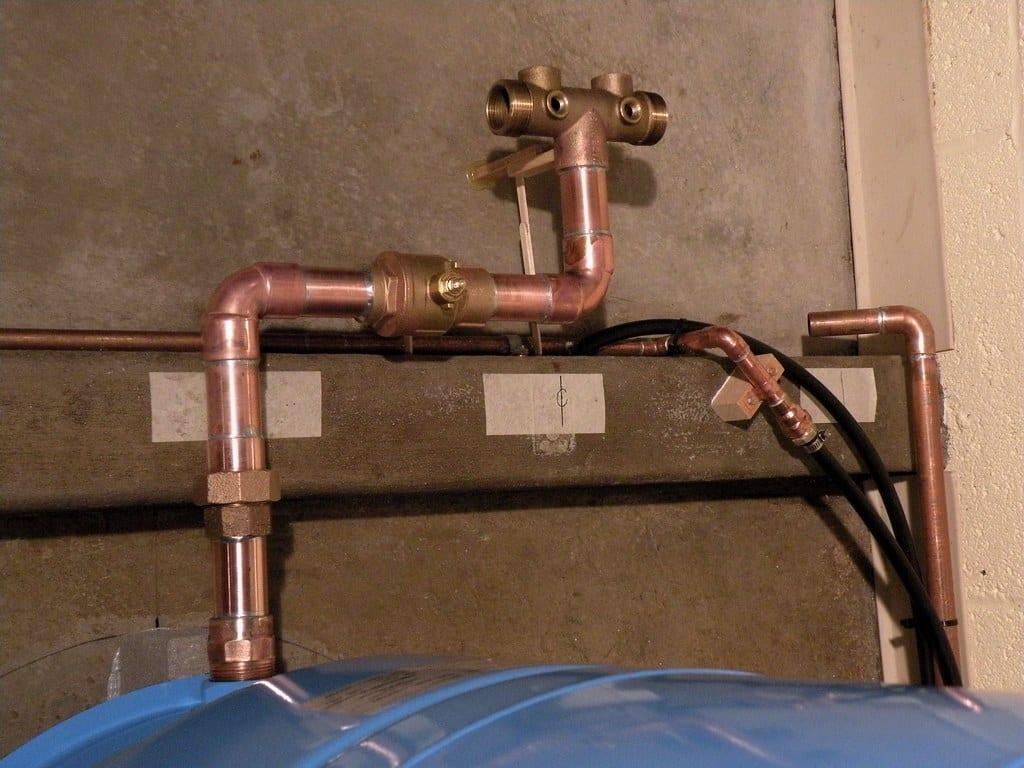
A city water sump pump backup — a water-powered backup — works if your house is on municipal water, your static pressure is inside the manufacturer's range, and you can feed it from a 3/4 inch supply branch with proper backflow protection. The Liberty SumpJet SJ10A, for example, is specified for a 20 to 100 PSI inlet and removes roughly two gallons of sump water for every gallon of supply water it uses. If you are on a private well, the answer is no — a well pump needs electricity, so in a power cut there is no pressure to drive it.
What makes this class of backup attractive is that it has no runtime limit. A battery backup gives you hours. A water-powered backup keeps going for as long as the municipal main stays pressurized, which in most outages is indefinitely.
The three checks, before you buy anything
- Confirm you are on municipal waterIf your water comes from a private well, stop here. The well pump is electric, so the moment the power goes out your supply pressure goes with it — which is precisely when you need the backup. A pressure tank holds a small reserve, nowhere near enough to run a backup pump through an outage. On a well, the answer is a DC battery backup or a generator.
- Measure your static pressureScrew a pressure gauge onto an outside spigot or a laundry tap with nothing else running. The Liberty SJ10A wants 20 to 100 PSI at the inlet; most municipal supplies sit somewhere in the 40 to 80 PSI range. If you are near the bottom of the range, take the reading again during peak demand in the evening, because that is when it will be lowest — and that is the number that matters.
- Check you can feed it properlyThe SJ10A takes a 3/4 inch inlet, and it needs a supply branch that can actually deliver. Teeing a water-powered backup off a 1/2 inch line, or off a long run already feeding other fixtures, starves it and it will not reach its rated flow. Look at where your main enters the basement and whether a dedicated 3/4 inch branch is practical from there.
What you give up, and what you gain
| Water-powered | DC battery backup | |
|---|---|---|
| Runtime | Unlimited while the main stays pressurized | Hours, set by battery capacity |
| Consumables | None — no battery to replace | A battery every few years |
| Flow at 10 ft | 1,020 GPH at 8 ft and 912 at 12 ft (SJ10A) | 1,000 to 1,800 GPH depending on the unit |
| Running cost | Metered water, about 1 gallon used per 2 removed | Trickle charge, negligible |
| Needs | Municipal pressure, 3/4" branch, backflow protection | A battery and somewhere dry to put it |
| Works on a well? | No | Yes |
| Pit space | Ceiling-mount options need none | Needs room in the basin |
| Fails when | The municipal supply is interrupted | The battery is flat or old |
The flow comparison is closer than people assume. A water-powered backup is not a weak substitute for a DC pump — the SJ10A publishes 1,020 GPH at eight feet of lift, which is in the same territory as several battery backups at ten feet. What it gives you on top of that is the absence of a runtime cliff.
Liberty Pumps SumpJet SJ10A
A water-powered backup specified for a 20 to 100 PSI inlet that removes about two gallons of sump water per gallon of supply water, with an indoor alarm included.
#ad we earn a commission · Amazon shows the current price
| Type | Water-powered backup, no electricity and no battery |
|---|---|
| Supply pressure | 20 to 100 PSI inlet |
| Connections | 3/4" inlet, 1-1/2" discharge |
| Water used | Removes about 2 gallons of sump water per gallon of supply water |
| Alarm | Indoor 115 V alarm with 9 V battery backup, included |
| Flow, by lift | 1,188 GPH at 4 ft · 1,020 GPH at 8 ft · 912 GPH at 12 ft · 810 GPH at 15 ft |
This is the water-powered backup to compare the others against, mostly because Liberty publishes the numbers you need to make the decision. The 20 to 100 PSI inlet range is the figure that decides whether your house can run one at all, and the roughly two-to-one removal ratio tells you what it costs in metered water.
The flow curve is unusually complete for this category: 1,188 GPH at four feet of lift down to 810 GPH at fifteen feet. Compare that to your inflow rather than to a battery backup's figures — a water-powered pump moves less water than a DC pump but it moves it for as long as the outage lasts, which is a different kind of protection.
The included indoor alarm is the detail that makes it livable. A water-powered backup that has been quietly running for two days is a water bill you want to know about, and an alarm you can hear upstairs is how you find out.
What it gets right
- 20 to 100 PSI inlet range published, which covers the great majority of municipal supplies
- Removes roughly 2 gallons of sump water per gallon of supply water used
- Flow published at four lifts: 1,188 GPH at 4 ft, 1,020 at 8 ft, 912 at 12 ft, 810 at 15 ft
- 3/4" inlet and 1-1/2" discharge
- Indoor 115 V alarm with 9 V battery backup included, so you know when it has been running
Where it falls short
- Needs a 3/4" supply branch — a 1/2" tap will not feed it properly
- Every gallon it uses appears on your water bill
- No electricity means no electricity: it will not work during a supply interruption either
- Requires correct backflow protection, which is not optional
Specifications from Liberty SumpJet SJ10A specification listing.
Basepump RB750-EZ
A ceiling-mounted water-powered backup rated at about 15 GPM at 15 feet of lift, which takes up no pit space at all.
#ad we earn a commission · Amazon shows the current price
| Type | Water-powered backup, ejector mounted on the ceiling joist above the pit |
|---|---|
| Rated capacity | 725 GPH, measured at 10 ft of lift on 50 PSI average supply pressure |
| Water used | Basepump states 1 gallon of city water removes 2 gallons of sump water in its bullets, and 1.5 to 2 gallons in its table |
| Moving parts | Hydraulic float; no electrical parts at all |
| Run-on | A timer keeps the ejector running about 30 to 45 seconds after the float drops |
| Alarm | A high-water alarm is included with every pump |
| Radon | Compatible with a sealed radon pit cover |
| Warranty | Five years |
The argument for a ceiling-mounted unit is geometry. If your basin already holds a primary pump, its float and a check valve, there may be no honest way to fit a second pump — and this is the configuration that sidesteps the problem entirely by not going in the pit at all.
It is more plumbing work in exchange. You are running supply and suction lines to a ceiling-mounted unit rather than dropping a pump into a hole, and that is a job to plan rather than improvise.
What it gets right
- Mounts at the ceiling, so a crowded basin is no longer a constraint
- About 15 GPM at 15 ft of lift rated — strong performance at real lift
- Nothing in the pit to foul, silt up or corrode
- No battery to replace on a schedule
Where it falls short
- Ceiling installation is a more involved plumbing job than a pit-mounted pump
- Still needs a proper supply branch and backflow protection
- Specification published is a single capacity point rather than a curve
Basepump HB1000-PRO
A brass-bodied water-powered backup rated at about 23 GPM, for a pit with serious inflow.

#ad we earn a commission · Amazon shows the current price
| Type | Water-powered backup, the high-performance model in the same line |
|---|---|
| Rated capacity | 950 GPH, measured at 10 ft of lift on 50 PSI average supply pressure |
| Versus the RB750 | About 31% more water moved on the manufacturer's own table, for a higher price |
| Moving parts | Hydraulic float; no electrical parts at all |
| Alarm | A high-water alarm is included with every pump |
| Warranty | Five years |
Buy this one only after you have measured your supply properly. The higher the pump's rated capacity, the more supply flow it wants, and a pump that starves at the inlet will not deliver its rating. Do the pressure and flow checks below before choosing between the three units on this page.
What it gets right
- About 23 GPM rated capacity, the highest water-powered figure in our registry
- Brass body rather than plastic
- Ceiling-mounted, so no pit space needed
Where it falls short
- Uses more supply water per minute than the smaller units, which is a real bill
- Needs the most supply capacity of anything on this page
- Published as a single rated figure rather than a curve
Specifications from Basepump product comparison table: HB1000 950 GPH at 10 ft lift on 50 PSI average pressure, against 725 GPH for the RB750 and 1,450 GPH for the commercial CB1500, Water Damage Defense retail listing for the HB1000-PRO (checked 2026-11-12).
The backflow question, which is not optional
Some jurisdictions restrict or prohibit water-powered backups for exactly this reason, and some require a specific device or an inspection. It is a short phone call to the building or water department and it determines whether the whole plan is viable.
What it will cost you in water
The SJ10A removes about two gallons of sump water for every gallon of supply water it consumes. So if your pit needs a thousand gallons moved during an outage, that is roughly five hundred gallons on your water bill — a trivial amount for a short outage, and a noticeable one if the pump runs for days.
This is the reason the SJ10A's included indoor alarm matters more than it sounds. A water-powered backup makes very little noise and has no display, so without an alarm you may not know it has been running at all until the bill arrives. Treat the alarm as part of the system, not an accessory.
Who should buy one
- Houses on municipal water with outages that last days rather than hours. This is the configuration water-powered backups are genuinely best at.
- Basins with no room for a second pump, using a ceiling-mounted unit.
- Owners who will not maintain a battery. A battery that is five years old and unverified is not a backup; a water-powered unit has nothing to forget.
- Second homes and rentals, where nobody is on site to check a battery.
And who should not: anyone on a well, anyone whose peak-demand pressure falls below the manufacturer's minimum, and anyone whose local code rules this out. In those cases the best battery backup for an existing sump pump is the route.
Questions people ask
How does a city water sump pump backup work?
It uses the pressure in your municipal water supply to drive a venturi, which draws sump water up and out of the pit. There is no motor, no electricity and no battery. The Liberty SumpJet SJ10A is specified for a 20 to 100 PSI inlet and removes about two gallons of sump water per gallon of supply water it uses.
Will a water-powered sump pump backup work on a well?
No. A private well's pump is electric, so when the power fails the water pressure fails with it — exactly when the backup is needed. The small reserve in a pressure tank is nowhere near enough to run a backup pump through an outage. On a well, use a DC battery backup or a generator.
What water pressure does a water-powered backup need?
Check the specific unit. The Liberty SumpJet SJ10A publishes a 20 to 100 PSI inlet range. Measure your static pressure with a gauge on an outside spigot during peak evening demand rather than mid-morning, because the low reading is the one that governs whether the pump will perform.
Does a water-powered backup need backflow protection?
Yes. It creates a connection between your potable supply and a sump pit, which is a cross-connection, and it must be protected so sump water can never be drawn back into the drinking water system. Manufacturers specify what their unit requires and local plumbing codes govern what is acceptable — some jurisdictions restrict these units entirely, so check before buying.
How much water does a water-powered backup use?
Roughly one gallon of supply water for every two gallons of sump water removed, on the SumpJet SJ10A. That is negligible for a short outage and noticeable over several days of continuous running, which is why an audible indoor alarm is worth treating as part of the system.
Sources
Read next
The best water-powered backup sump pumps
No battery, no charger, no runtime limit. In the houses where it fits, this is the most reliable backup you can install.
Water-powered vs battery backup sump pump
One has no runtime limit and four conditions attached. The other works anywhere and runs out. That is the whole decision.

The best battery backup for an existing sump pump
Your primary pump is fine. You want the outage covered without tearing the pit apart. These are the systems that do that.

Do I need a battery backup sump pump?
The storms that fill your pit are the storms that take the power down. The question is what a few hours of no pumping would actually cost you.
Battery backup vs generator for a sump pump
One works while you sleep at reduced flow. The other gives full flow but needs you awake and outside. They are not really competing.